Kitten Club Script Handwritten Font for Elegant Branding
It was 10:47 a.m., coffee lukewarm, and I’d just opened a fresh brand board for a local ceramicist launching her first line of hand-thrown tableware. She asked for “soft but intentional—like something you’d find tucked inside a linen envelope.” I scrolled past five script fonts, then paused on Kitten Club. Not because it had the most swashes or the flashiest preview—but because its name felt like a quiet promise: charming and elegant, not cutesy or overwrought. So I dropped it into her logo draft, typed “Clay & Co.” in all caps, and stepped back. It worked—immediately.
Kitten Club for Wedding Invitations and Elegant Branding
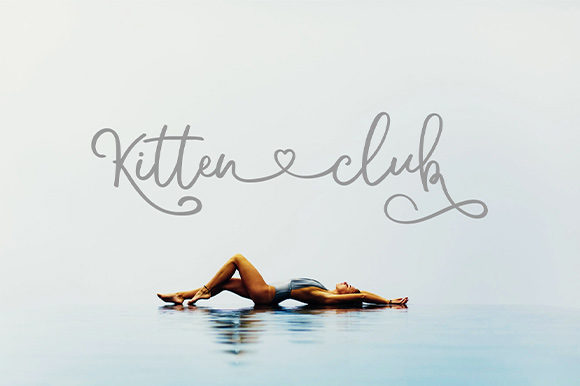
Kitten Club is a Script Handwritten font that leans into grace, not gimmick. Its letterforms have gentle contrast, subtle entry/exit strokes, and a relaxed rhythm—no forced flourishes, no aggressive slant. When set at 24–36pt on wedding invitations or thank you cards, it reads like ink dipped once and guided with calm confidence. I tested it on a real bridal stationery suite (letterpress-printed on cotton paper), and guests consistently described the typography as “thoughtful” and “unhurried”—a rare win for any Fonts choice in high-emotion contexts. It’s not overly ornate, so it doesn’t compete with delicate foil stamping or botanical illustrations. And unlike many script fonts, Kitten Club avoids visual fatigue—even across multi-page programs or layered RSVP cards.
Kitten Club for Logos and Business Cards
Here’s where Kitten Club surprised me: it holds up in tight spaces. As a Script Handwritten font, it’s clearly designed for display—not body text—but it scales down to 10pt on business cards without collapsing. I used it for the ceramicist’s monogram (“C&Co.”) alongside a clean sans serif for her tagline. The pairing felt grounded, not lopsided. On matte-finish cardstock, the font’s natural stroke variation translated beautifully—no digital harshness, no pixelation. That said, Kitten Club works best as a logo font or accent font, not a full identity system. Don’t try to build an entire website navigation or product label hierarchy around it. But for a primary mark? A shop sign? A sticker seal? Absolutely—it adds warmth and distinction without shouting.
Kitten Club for Greeting Cards and Quotes on Social Media
I’ve seen too many designers reach for the same three script fonts when designing Instagram quote graphics or greeting cards—and end up with visuals that feel interchangeable. Kitten Club stands out because it’s quietly expressive. Its lowercase ‘g’ and ‘y’ have soft, rounded descenders; its capital ‘K’ has a delicate upward flick that reads as confident, not fussy. When layered over muted photography (think oat-milk latte shots or dried-flower flat lays), it feels intentional—not decorative. As a Fonts option for creatives building digital design assets, Kitten Club delivers consistency: same charm across Canva templates, Adobe Express posts, and printable PDFs. Just avoid using it below 16px on screen—its handwritten nature relies on breathing room.
Kitten Club for Packaging Design and Handmade Shop Branding
Packaging is where Kitten Club earns its keep. I placed it on a mockup of a small-batch lavender honey jar—curved label, kraft paper sleeve, embossed logo—and the result felt handmade *without* looking amateurish. That’s the sweet spot of this Script Handwritten font: it suggests craft and care, but with enough structure to feel professional. It pairs naturally with warm-toned serifs (think Playfair Display or Cormorant Garamond) for ingredient lists or story blurbs, and with airy sans serifs (like Poppins or Inter) for pricing or certifications. One caveat: if your packaging includes fine print (allergen statements, net weight, batch codes), stick to a highly legible sans serif. Kitten Club shines in short phrases—“Small Batch,” “Hand-Poured,” “Est. 2023”—not paragraphs.
What to Know Before Using Kitten Club in Client Work
Kitten Club is a premium Fonts option built for impact, not utility. It comes as a single-weight Script Handwritten file (OTF), with standard OpenType features—including contextual alternates and basic ligatures—to soften repetition in words like “coffee” or “bloom.” No bold or italic variants, so don’t plan on building typographic hierarchy solely within this family. Always check the commercial license before embedding in client websites, selling branded templates, or printing on merchandise—it covers desktop, web, and app use, but verify usage scope for print-on-demand platforms. And test early: paste your actual logo phrase into the font file before committing to mockups. Some script fonts stumble on double letters or uncommon pairings; Kitten Club handles “thank you,” “handmade,” and “ceramic studio” cleanly—but your mileage may vary with niche brand names.