Sour Apple Font for Small Business Branding
Two weeks ago, I was holding a freshly printed batch of candle labels—my third round this month—and realizing something wasn’t clicking. The font I’d been using felt stiff, generic, and oddly cold next to the warm soy wax, hand-poured scents, and linen tags I’d carefully chosen. My customers loved the experience—the soft glow, the lavender-vanilla scent, the handwritten notes tucked inside each box—but the visuals? They didn’t feel like *me*. That’s when I searched “friendly handwritten fonts for small business” and found Sour Apple.
Sour Apple for Candle Labels and Handmade Product Packaging
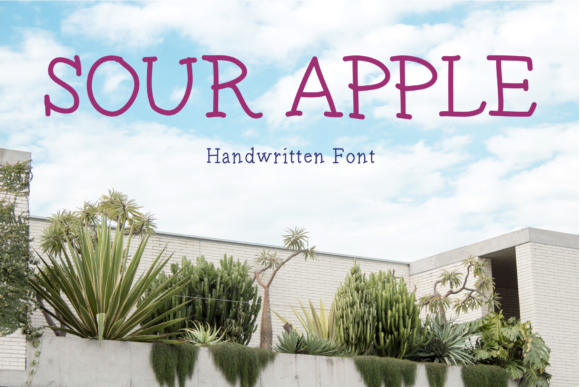
Sour Apple is a Script Handwritten font that feels like a smile in type form—sweet, approachable, and quietly confident. It’s not overly ornate or fussy; instead, it has gentle loops, relaxed spacing, and subtle variations that mimic real pen-on-paper movement. As a small-batch candle maker, I needed a font that could sit beautifully on 2-inch jar labels without looking cramped or pixelated—and Sour Apple delivered. Its natural rhythm makes short phrases like “Cedar & Rain” or “Hand-Poured in Portland” feel personal, not promotional. Because it’s a well-designed Fonts file with clean vector outlines, it scales flawlessly from tiny sticker text to large shop signage.
Sour Apple for Café Menus and Local Business Signage
I tested Sour Apple on our café’s laminated menu board—replacing the default script font that looked like it belonged in a 2004 PowerPoint slide. Instantly, the vibe shifted: warmer, more human, less “corporate coffee chain,” more “the barista remembers your name.” As a Script Handwritten typeface, Sour Apple shines in display roles—menu headers, chalkboard specials, takeaway cup sleeves—not body copy. It’s ideal for short bursts of personality: “Today’s Special,” “Oat Milk Latte,” “Baked Fresh Daily.” Just keep line lengths tight, avoid all caps for long phrases, and pair it with a light sans serif (like Poppins or Inter) for prices and descriptions. That contrast keeps things readable while letting Sour Apple do the emotional heavy lifting.
Sour Apple for Social Media Graphics and Instagram Story Templates
When I updated my Instagram highlight covers and story templates with Sour Apple, engagement ticked up—not because of some algorithm hack, but because people paused. The font’s friendly bounce made quotes (“Slow down. Breathe. Light a candle.”) feel like quiet encouragement, not marketing noise. As one of the most versatile Fonts in the Script Handwritten category, Sour Apple works across platforms: crisp on mobile thumbnails, charming in Reels captions, elegant in Pinterest pins. Pro tip: Use it at 36–48pt for stories, and always check readability against busy backgrounds—its open letterforms hold up better than tighter scripts on textured photos or gradient overlays.
Sour Apple for Wedding Invitations and Elegant Branding
Even though I’m not a wedding stationer, I borrowed inspiration from how Sour Apple is used by boutique creatives—and adapted it. For custom gift boxes and thank-you cards sent with orders, I swapped out my old serif font for Sour Apple. Suddenly, “Thank you for supporting small” didn’t read like a receipt—it read like a note from a friend. Its elegance isn’t formal or distant; it’s soft, sincere, and quietly refined. That’s the magic of this Script Handwritten font: it bridges handmade charm and polished professionalism without trying too hard. Perfect for brands that want warmth *and* credibility—especially when paired with quality paper stock or foil-stamped finishes.
Sour Apple for Skincare Labels and Clean Beauty Packaging
Clean beauty buyers notice details—the texture of a label, the weight of a bottle, the tone of every word. So when I redesigned my lavender toner label, I chose Sour Apple for the product name and “Alcohol-Free • Plant-Based” tagline. Its natural flow complements minimalist design without sacrificing character. As a Fonts file, it includes standard OpenType features—ligatures, stylistic alternates, and multilingual support—so I could easily tweak “Lavender Mist” to avoid awkward letter collisions. And yes, it’s fully licensed for commercial use: printing on glass bottles, embroidering onto cotton pouches, embedding in Shopify banners—no hidden restrictions.
Sour Apple for Logo Design and Small Business Brand Identity
I didn’t rebuild my entire logo—but I *did* refresh the wordmark portion using Sour Apple. Not as the full logo lockup, but as the primary script element layered over a simple sans serif base. That combo gave me instant cohesion: consistent across packaging, website headers, and Etsy listings. Sour Apple isn’t meant for tiny favicons or ultra-thin embroidery threads, but it *is* perfect for logotypes, monograms, and signature-style branding elements where personality matters most. As a Script Handwritten font, it helps signal authenticity—a subtle cue that says “this was made by hand, with care.”
How to Use Sour Apple Effectively Across Your Business
- Best for: Headlines, product names, greeting cards, social quotes, packaging accents, and logo submarks
- Avoid for: Long paragraphs, fine print, ultra-small labels (<5pt), or low-resolution digital ads
- Pair with: A neutral sans serif (for balance), a delicate serif (for contrast), or even another friendly handwritten font (for layered texture)
- Check before buying: File formats (OTF/TTF), included weights (Sour Apple is a single-weight display font), and commercial license scope—especially if selling physical goods or digital templates
Typography isn’t just decoration. It’s the first handshake between your brand and someone scrolling, shopping, or stepping into your space. With Sour Apple, that handshake feels genuine—warm, unhurried, and unmistakably yours. It’s the kind of Script Handwritten font that doesn’t shout, but still gets remembered. And in a world full of sameness, that’s worth every penny.